TOKURIKI TOMIKICHIRO (1902-2000)
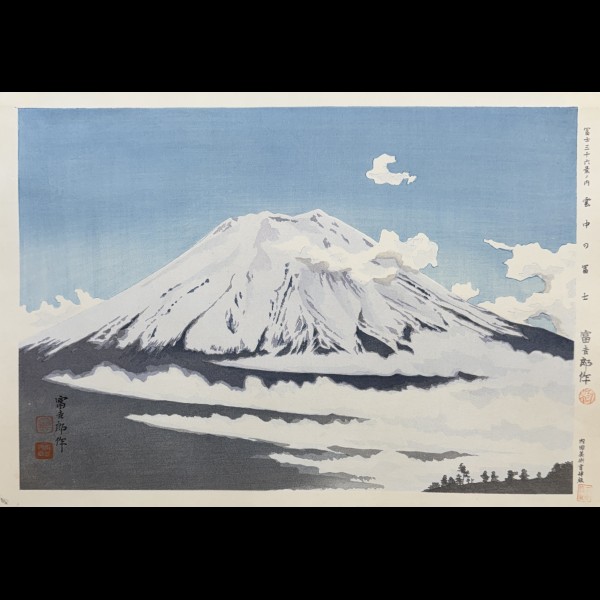
UNCHU NO FUJI, FUJI DANS LES NUAGES
From the series: "Thirty-six Views of Mount Fuji," published by Uchida Bijutsu Shoten between 1939 and 1940, which is both a more modern interpretation and a tribute to Hokusai's famous series of the same name, created between 1826 and 1833. A superb impression from one of the very first printings, featuring embossing in the clouds and on Mount Fuji.One of the finest prints in this series.Shin-hangaNishiki-eTokuriki's series was an immense success with foreign buyers upon its release.This series is undoubtedly Tokuriki's masterpiece and surpasses his other major series, "Scenes of Sacred Places and Historical Monuments (Seichi Shiseki Meisho)."After World War II, he created another version in a sosaku-hanga style, which he called "Thirty-six New Views of Mount Fuji."..
800.00 €
TEMPLE DE KIYOMIZU, KYOTO
From the series: Twelve Themes of Kyoto.Beautiful print numbered and signed, lovely colors,Shin HangaNishiki-eKiyomizu-dera (lit. 'Monastery of Pure Water') is a Buddhist temple located in eastern Kyoto. It was founded in 778, at the end of the Nara period, by Enchin Shonin, a priest from Nara (the ancient capital of Japan from 710 to 784).Tomikichiro Tokuriki was a Japanese woodblock printmaker, representing the twelfth generation of a family of Kyoto artisans. He graduated from the Kyoto City School of Fine Arts and the Kyoto City Specialist School of Painting in 1924. After World War II, he founded the Matsukyu publishing company to produce and distribute his own prints as well as Shin Hanga and Sosaku Hanga works by other artists. Tomikichiro Tokuriki was an influential figure in the contemporary print movement in Japan. He was the official artist of the Honganji Temple and was commissioned to engrave various temples throughout Japan, including the famous shrines of Ise. His prints are held in the collections of the Museum of Fine Arts, Boston, and the Museum of Modern Art, New York...
450.00 €
FESTIVAL DE GION LE 17 JUILLET
From the set: The four seasons of KyotoShin-HangaNishiki-eVery beautiful and fresh proof bearing the artist's red stamp and signed in pencilCa.1950The Gion Matsuri in Kyoto is one of the three largest local festivals in Japan. The other two are Kanda Matsuri in Tokyo and Tenjin Matsuri in Osaka. The Gion Matsuri can be considered the largest and most spectacular. It is held every year from July 1 to 31 for the celebration of the summer solstice at Yasaka Jinja Shrine. The two key dates of this celebration take place on July 17 (Saki Matsuri or pre-festival) and July 24 (Ato Matsuri or post-festival) when all thirty-four floats crisscross the main streets of the city.Its origin dates back to the plague of 869. The emperor sent a special messenger to Yasaka Jinja, the ancient name of the shrine of Gion known to house the spirit of the brother of the sun goddess supposed to fight this evil, to pray and him To do this, he ordered the creation of sixty-six halberds representing the sixty-six provinces of the country.Once the epidemic was stopped, the inhabitants of Kyoto decided from 970, in gratitude, to organize a festival each year...
380.00 €
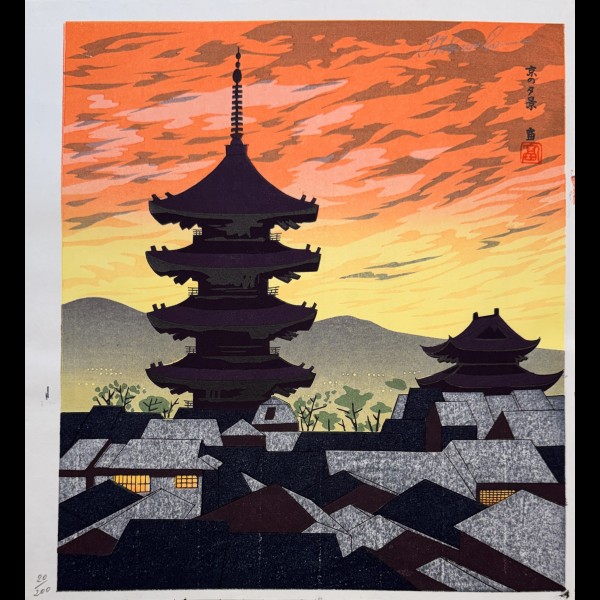
VUE NOCTURNE DE KYOTO, PAGODE YASAKA
From the series: Twelve Views of the Four Seasons of KyotoBeautiful signed and numbered print, lovely colors,Shin HangaNishiki-eCirca 1970Yasaka Pagoda, also known as Hokan-ji Temple, is an iconic historical landmark of Kyoto's rich cultural heritage. Located in Higashiyama Ward, it stands amidst 1,600 Buddhist pagodas, 400 Shinto shrines, and numerous palaces and gardens. This iconic five-story pagoda is a testament to traditional Japanese craftsmanship and has been an integral part of Kyoto's cityscape for centuries. Its earthquake-resistant construction, in particular, illustrates the ingenuity of ancient Japanese engineers.Yasaka Pagoda has been a recurring subject in Japanese prints for centuries. Renowned artists such as Teruhide Kato, Clifton Karhu, Tomikichiro Tokuriki, Toshijiro (Nenjiro) Inagaki and Takeji Asano have immortalized it in numerous prints, celebrating its beauty through the seasons and under different lights.Tomikichiro Tokuriki was a Japanese woodblock printmaker, representing the twelfth generation of a family of Kyoto artisans. He graduated from the Kyoto City School of Fine Arts and the Kyoto City Specialist School of Painting in 1924. After World War II, he founded the Matsukyu publishing company to produce and distribute his own prints as well as Shin Hanga and Sosaku Hanga works by other artists. Tomikichiro Tokuriki was an influential figure in the contemporary print movement in Japan. He was the official artist of the Honganji Temple and was commissioned to engrave various temples throughout Japan, including the famous shrines of Ise. His prints are held in the collections of the Museum of Fine Arts, Boston, and the Museum of Modern Art, New York...
450.00 €
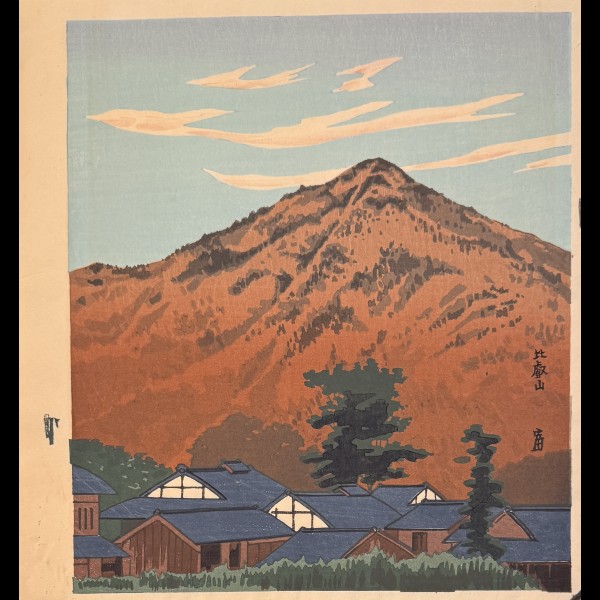
MONT HIEI
Fine impression, slight yellowing, ink stains on the outer left and right edges.Ca.1970/80Mount Hiei (Hiei-zan) is a mountain northeast of Kyoto, located on the border between Kyoto and Shiga Prefectures, Japan. Enryaku-ji Temple, the first of the Japanese Tendai (Chin. Tiantai) branch of Buddhism, was founded atop Mount Hiei by Saichō in 788 and quickly grew into a vast complex of temples and buildings.Tomikichiro Tokuriki was a Japanese woodblock printmaker, representing the twelfth generation of a family of Kyoto artisans. He graduated from the Kyoto City School of Fine Arts and the Kyoto City Specialist School of Painting in 1924. After World War II, he founded the Matsukyu publishing company to produce and distribute his own prints as well as Shin Hanga and Sosaku Hanga works by other artists. Tomikichiro Tokuriki was an influential figure in the contemporary print movement in Japan. He was the official artist of the Honganji Temple and was commissioned to engrave various temples throughout Japan, including the famous shrines of Ise. His prints are held in the collections of the Museum of Fine Arts, Boston, and the Museum of Modern Art, New York...
380.00 €
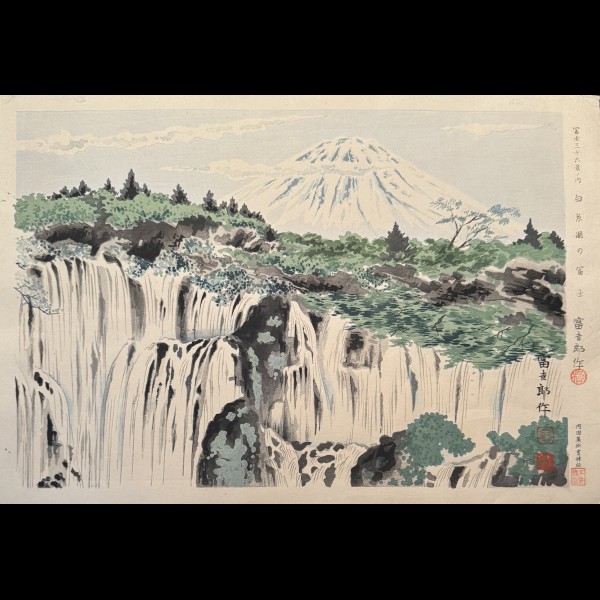
VUE DU FUJI DEPUIS LA VILLE D'IWABUCHI
From the series: "Thirty-six Views of Mount Fuji," published by Uchida Bijutsu Shoten between 1939 and 1940, which is both a more modern interpretation and a tribute to Hokusai's famous series of the same name, created between 1826 and 1833. Beautiful colors; remnants of an earlier assembly are visible in the upper and lower margins.Shin-hangaNishiki-eTokuriki's series was an immense success with foreign buyers upon its release.This series is undoubtedly Tokuriki's masterpiece and surpasses his other major series, "Scenes of Sacred Places and Historical Monuments (Seichi Shiseki Meisho)."After World War II, he created another version in a sosaku-hanga style, which he called "Thirty-six New Views of Mount Fuji."..
480.00 €
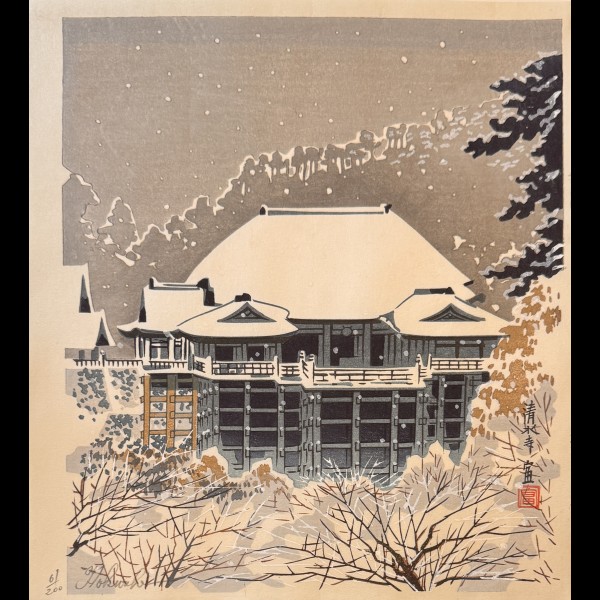
TEMPLE KIYOMIZU, KYOTO
From the series: Twelve Views of the Four Seasons of KyotoBeautiful print, numbered, lovely colors,Shin HangaNishiki-eMore than 1250 years have passed since the founding of Kiyomizu-dera Temple. Halfway up Mount Otowa, one of the mountains in the Higashiyama range in Kyoto, stands the temple, where a great number of visitors come to honor Kannon, a deity of mercy and compassion, which is why the temple is known as "Kannon's Reijo." "Reijo" means "holy place."Tomikichiro Tokuriki was a Japanese woodblock printmaker, representing the twelfth generation of a family of Kyoto artisans. He graduated from the Kyoto City School of Fine Arts and the Kyoto City Specialist School of Painting in 1924. After World War II, he founded the Matsukyu publishing company to produce and distribute his own prints as well as Shin Hanga and Sosaku Hanga works by other artists. Tomikichiro Tokuriki was an influential figure in the contemporary print movement in Japan. He was the official artist of the Honganji Temple and was commissioned to engrave various temples throughout Japan, including the famous shrines of Ise. His prints are held in the collections of the Museum of Fine Arts, Boston, and the Museum of Modern Art, New York...
400.00 €