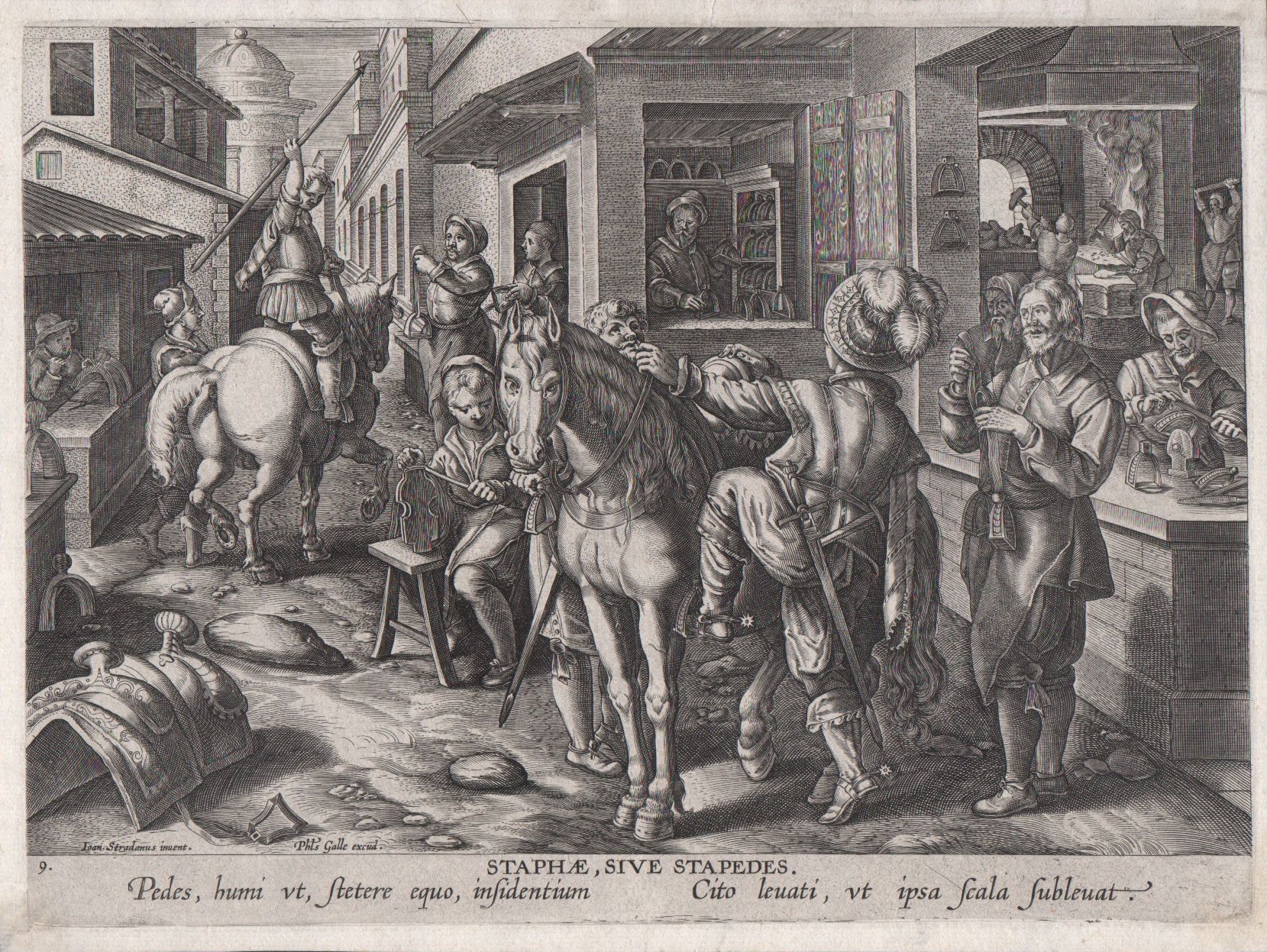
• STAPHAE, SIVE STAPEDES

Plate 9 from the Nova Reperta series.

State 2/4 with the number 9 in the lower left corner to the address of Philippe Galle, before its replacement by that of Johannes Galle.

(The series was first published around 1591 by Philippe Galle in Antwerp and was successively republished by Karel de Mallery, after 1612, Theodoor Galle, before 1636 and Johannes Galle before 1677.)
Very beautiful proof on laid paper watermarked with a double crowned C, the corners reinforced.
ca.1591

New Hollstein: 331


The Nova Reperta series, that is to say new discoveries (or inventions), illustrates certain notable discoveries and inventions for Europe at the end of the 16th century.

These repertae are highlighted and “situation” by Stradan in a lively and dramatic way, according to the advice given by humanist pedagogues like Erasmus and of which Jean-Claude Margolin gives an analysis in his: "About Stradan's Nova reperta" in "Esthétiques de la nouveauté à la Renaissance",Franck Lessay et François Laroque (dir.), Presses Sorbonne Nouvelle Collection, Paris, 2001

"Here is an outdoor scene, more precisely a street scene, where we see two riders: one (on the left), in front of a shop, is mounted on his horse (is he going to get off, or is he getting back on?), the other (on the right) is preparing to get back on, his left foot already placed on the stirrup (scala), seeming to take leave of a shopkeeper who is standing near him. He apparently obtained some practical object, or rather some essential ointment. What is it about? The title indicates this, as the Latin legend of the subscription will indicate more precisely. But these Latin, or Latin-Greek, terms, unknown to Cicero or Caesar, are not immediately assimilable, even if the radical sto-48 from which they are formed gives an idea of ​​stability, firmness or plumbness (in this case, of the feet). They actually mean so-called pedicle herbs49 which we also call filopodia, that is to say herbs which relieve the feet of these riders, wearing narrow and uncomfortable boots, and enduring long hours or long days on horseback, without being able to let them rest in the open air. Here is how the author of the Latin legend describes and interprets the image: Pedes, humi ut, stetere equo, insidentium, cito levati, ut ipsa scala sublevat (“Having dismounted, the riders, as soon as they remount, are quickly relieved, the stirrup itself delivering them from their suffering”)."


STAPHAE, SIVE STAPEDES

  • 1,500.00 €


”instagram_icon”

Guarantee of Authenticity

All our prints and engravings are guaranteed to be original.

Art Gallery in Paris

11 Passage Verdeau, Paris 9th. Recognized expertise in ancient and modern prints, Japanese and European. Member of SLAM (Syndicat de la Librairie Ancienne et Moderne) and ILAB (International League of Antiquarian Booksellers)

Conservation Museum Quality

Flat packaging, acid-free folders with neutral pH and reinforced protection.

Shipping within the European Union

Careful delivery within 24/48 hours with ad valorem insurance and real-time tracking.

Frequently Asked Questions from Collectors & Print Lovers

Answers on the authenticity, conservation and acquisition of Japanese prints and Master engravings.

How are the prints packaged and secured during delivery?

En résumé : The prints are protected in a neutral acid-free pouch, packaged strictly flat between two plates of rigid reinforced non-deformable cardboard with ad valorem insurance.

Prints are preferably shipped flat to preserve the fiber of the paper. Packages are shipped within 24 to 48 hours via Colissimo Expert with delivery against signature or express carrier (DHL / FedEx) with tracking number. Collection by hand from our Parisian gallery (11 Passage Verdeau) is also available during opening hours or on request.

How can we guarantee the authenticity and period print of an original print?

En résumé : An original print is verified by its edition, determined largely by the nature of its paper and the quality of its printing.

At the Maillard-Fouilleul Gallery, each work undergoes an in-depth examination, mention in the dedicated catalogs or directories, quality of the print and printing, possible presence of a watermark and its identification as well as any signature, sending or collector's mark, state of conservation of the print, integrity of the margins.

What is the difference between an Ukiyo-e print and a Shin-Hanga print?

En résumé : Ukiyo-e (17th–19th century) illustrates the classic “floating world” of Edo, while Shin-Hanga (20th century) renews woodcut with Western perspectives and light effects.

Ukiyo-e brings together illustrious masters like Hokusai, Hiroshige, Utamaro and Sharaku. The favorite subjects are actors, kabuki, courtesans or Bijin and landscapes, nature and its seasons being at the heart of art and the art of living in Japan. The Shin-Hanga (“new prints”) movement, launched by the publisher Watanabe Shozaburo in the years 1915-1960 with Hasui Kawase and Hiroshi Yoshida, preserves the traditional technique on wood with the intervention of a designer, an engraver and a printer, while infusing a spectacular atmospheric realism. To this we must add Sosaku-Hanga ("creative prints"), the creative process of which is in the hands of the artist alone and whose palette and graphic expression are freer.

How to properly preserve and frame a Japanese print or old engraving?

En résumé : Store prints away from UV rays and excessive humidity. Use only acid-free (neutral pH) mats and museum-quality anti-UV glass.

Inks like paper are very sensitive to direct light and humidity. We recommend reversible assembly with neutral pH or Japanese starch-based hinges, avoiding any synthetic adhesive. Never glue a print in full. For storage in drawing board, choose neutral polyester pouches (Melinex/Mylar) and permanent blotting paper.

Can you have your European and Japanese prints appraised or sold at the gallery?

En résumé : Yes, we examine your works for cash purchase, or valuation notice on photographs.

We are constantly looking for Japanese prints (Ukiyo-e, Shin-Hanga, Sosaku-Hanga), as well as engravings by ancient or modern European masters: Dürer, Callot, Bosse, Nanteuil, Boucher, Delacroix, Gericault, Goya, Rodin, Redon, Miro, Chagall, Buffet, Delaunay, Vasarely. You can send us photos by email to maillard.estampes@orange.fr or come and meet us directly at Passage Verdeau in Paris.

Galerie Maillard-Fouilleul · Specialist in ancient and modern prints · Ref. bibliographic: Hollstein, Bartsch, Le Blanc, I.F.F, Delteil, Last update: 09/2026.