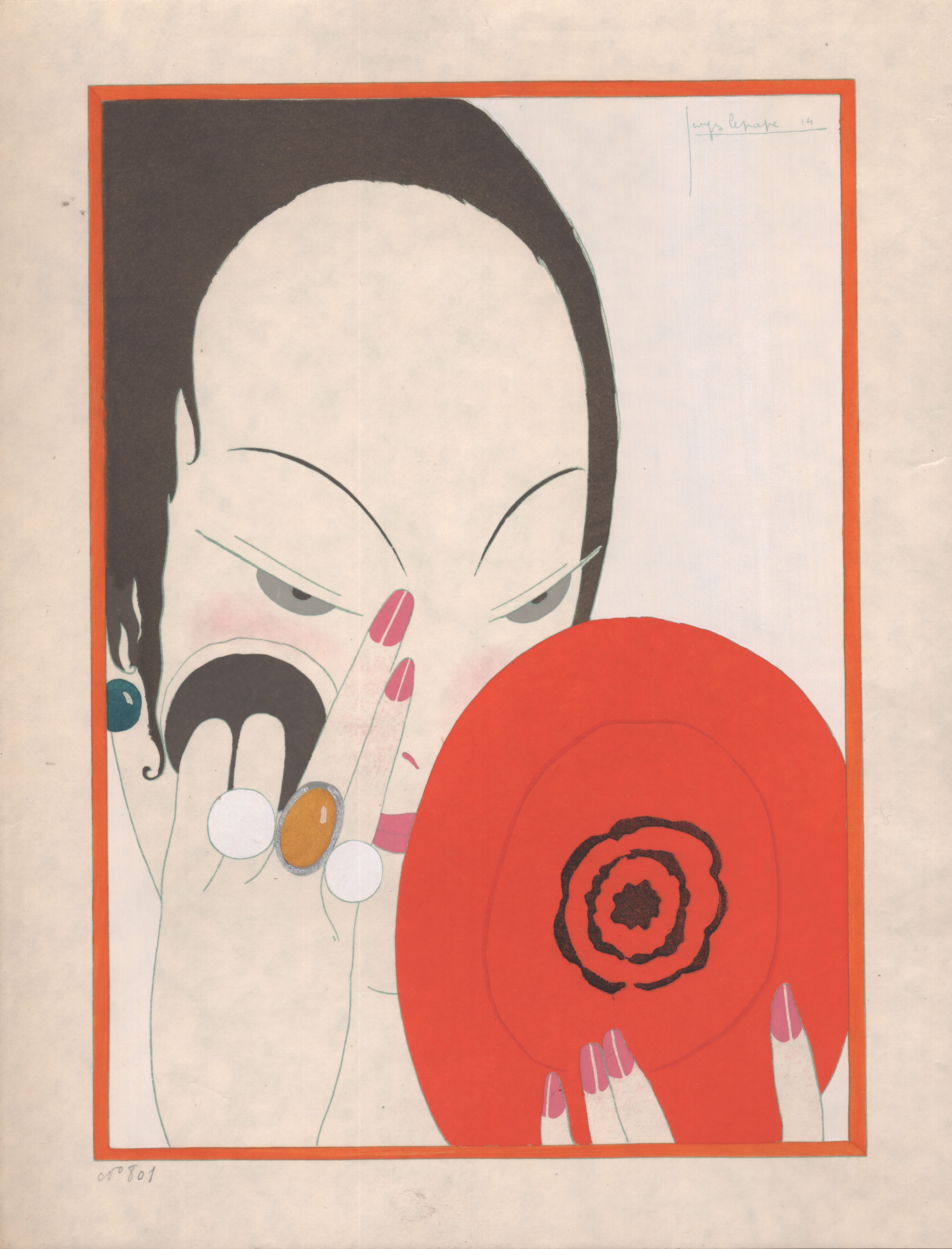
• LE MIROIR ROUGE

Beautiful stencil printed on pearlescent Japanese paper.

Minor abrasion in the bottom margin.

Silver highlights on the ring and the center of the mirror.

Deluxe edition from the magazine: Les Feuillets d'Art

Numbered proof 801

1919

It was with "Les Choses de Paul Poiret" in 1913, a sequel commissioned by the couturier to "Les Robes" in 1911, that the young Lepape laid the foundations for what would become his signature style: the influence of Japanese prints and the Ballets Russes, adapted to the demands of fashion.

This was a new era, both for fashion and for the engraving that depicted it. Abandoning mechanical color printing processes, illustrators brilliantly employed the stencil technique, championed by Jean Saude, himself an illuminator. The vibrancy and warmth of the tones, which had temporarily disappeared, were revived, giving fashion engraving a charm it had lost. At the time, this renewed interest in stenciling, a process particularly well-suited to their style, contributed to the production of a large part of their work. This technique had a long history in France, as it is known that playing card manufacturers were already using it in 15th-century Lyon.At the time, the support was a sheet of oiled cardboard, but the process perfected in France in the 20th century used a zinc or bronze plate. Skillfully employed, these perforated stencils allowed for the layering of colors and the reproduction of the original's hues, achieving almost infinite complexity. Jean Saude, one of the leading specialists in this technique, used more than thirty stencils to capture the freshness of a delicate watercolor.
Compared to photographic or entirely mechanical reproduction methods, stenciling was slow and laborious, but this was precisely the reason for its popularity with Saude, Vogel, and other publishers who sought the highest quality. Proceeding in successive layers, and thus preserving the virtues of handwork at every stage, it allowed for the creation of copies that remained remarkably faithful to the spirit of the original.
From Japanese prints, Lepape and many others had learned to arrange curvilinear figures against a rectilinear background, to create an impression of tilting, spiraling, and aerial height with an economy of means pushed to the extreme, often achieving this new vibrancy by completely eliminating the background. In their compositions, the foreground is often steeply inclined, causing the background to disappear, the background then becoming a backdrop, as in a theater. The bold palette of the Fauves and the brighter colors adopted by haute couture gave illustrators the courage to begin using previously unheard-of contrasts. The Cubists brought new interpretations of mass and space.
The Red Mirror clearly indicates this new spatial balance, the unprecedented experiments with color, and the bold treatment of the human face, all fueled by an observation of a world permeated by new technologies and a thirst for distant horizons. These few brushstrokes for the eyebrows, nose, and mouth lend the model a sensual exoticism inspired by Japan, which the mirror, in a beni iro hue (the color of eyeshadow), and the delicate hands with their momo iro pink (peach-colored) nails reinforce and amplify. Here, too, we find an aesthetic undoubtedly drawn from the contemplation of the new interpretations of the human face established by Modigliani, but also from the influence of silent cinema, where lighting effects accentuated an exaggeratedly heavy eyelid against livid complexions, thus blurring the contours to give faces an ethereal quality.

Bibliography:
-La Gravure De Mode Feminine En France, Raymond Gaudriault, Les éditions de l'amateur, 1983
- La Mode Art Déco, L'âge D'or Du Style, Julian Robinson, Editions Atlas, 1977


LE MIROIR ROUGE

  • Author : LEPAPE GEORGES (1887-1971)
  • Technic: Pochoir

  • Width : 178.00
  • Height : 246.00
  • Leaf width : 220.00
  • Leaf height : 285.00

  • Availability: In Stock
  • 1,200.00 €


”instagram_icon”

Guarantee of Authenticity

All our prints and engravings are guaranteed to be original.

Art Gallery in Paris

11 Passage Verdeau, Paris 9th. Recognized expertise in ancient and modern prints, Japanese and European. Member of SLAM (Syndicat de la Librairie Ancienne et Moderne) and ILAB (International League of Antiquarian Booksellers)

Conservation Museum Quality

Flat packaging, acid-free folders with neutral pH and reinforced protection.

Shipping within the European Union

Careful delivery within 24/48 hours with ad valorem insurance and real-time tracking.

Frequently Asked Questions from Collectors & Print Lovers

Answers on the authenticity, conservation and acquisition of Japanese prints and Master engravings.

How are the prints packaged and secured during delivery?

En résumé : The prints are protected in a neutral acid-free pouch, packaged strictly flat between two plates of rigid reinforced non-deformable cardboard with ad valorem insurance.

Prints are preferably shipped flat to preserve the fiber of the paper. Packages are shipped within 24 to 48 hours via Colissimo Expert with delivery against signature or express carrier (DHL / FedEx) with tracking number. Collection by hand from our Parisian gallery (11 Passage Verdeau) is also available during opening hours or on request.

How can we guarantee the authenticity and period print of an original print?

En résumé : An original print is verified by its edition, determined largely by the nature of its paper and the quality of its printing.

At the Maillard-Fouilleul Gallery, each work undergoes an in-depth examination, mention in the dedicated catalogs or directories, quality of the print and printing, possible presence of a watermark and its identification as well as any signature, sending or collector's mark, state of conservation of the print, integrity of the margins.

What is the difference between an Ukiyo-e print and a Shin-Hanga print?

En résumé : Ukiyo-e (17th–19th century) illustrates the classic “floating world” of Edo, while Shin-Hanga (20th century) renews woodcut with Western perspectives and light effects.

Ukiyo-e brings together illustrious masters like Hokusai, Hiroshige, Utamaro and Sharaku. The favorite subjects are actors, kabuki, courtesans or Bijin and landscapes, nature and its seasons being at the heart of art and the art of living in Japan. The Shin-Hanga (“new prints”) movement, launched by the publisher Watanabe Shozaburo in the years 1915-1960 with Hasui Kawase and Hiroshi Yoshida, preserves the traditional technique on wood with the intervention of a designer, an engraver and a printer, while infusing a spectacular atmospheric realism. To this we must add Sosaku-Hanga ("creative prints"), the creative process of which is in the hands of the artist alone and whose palette and graphic expression are freer.

How to properly preserve and frame a Japanese print or old engraving?

En résumé : Store prints away from UV rays and excessive humidity. Use only acid-free (neutral pH) mats and museum-quality anti-UV glass.

Inks like paper are very sensitive to direct light and humidity. We recommend reversible assembly with neutral pH or Japanese starch-based hinges, avoiding any synthetic adhesive. Never glue a print in full. For storage in drawing board, choose neutral polyester pouches (Melinex/Mylar) and permanent blotting paper.

Can you have your European and Japanese prints appraised or sold at the gallery?

En résumé : Yes, we examine your works for cash purchase, or valuation notice on photographs.

We are constantly looking for Japanese prints (Ukiyo-e, Shin-Hanga, Sosaku-Hanga), as well as engravings by ancient or modern European masters: Dürer, Callot, Bosse, Nanteuil, Boucher, Delacroix, Gericault, Goya, Rodin, Redon, Miro, Chagall, Buffet, Delaunay, Vasarely. You can send us photos by email to maillard.estampes@orange.fr or come and meet us directly at Passage Verdeau in Paris.

Galerie Maillard-Fouilleul · Specialist in ancient and modern prints · Ref. bibliographic: Hollstein, Bartsch, Le Blanc, I.F.F, Delteil, Last update: 09/2026.