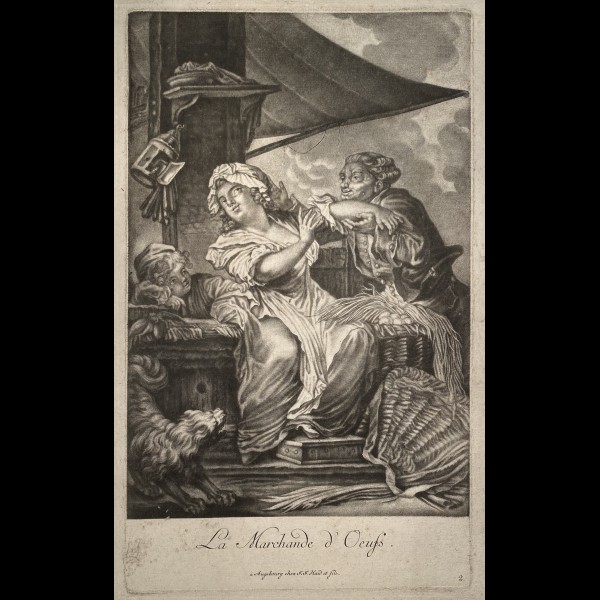
HAID JOHANN-JAKOB (1704-1767) - LA MARCHANDE D'OEUFS
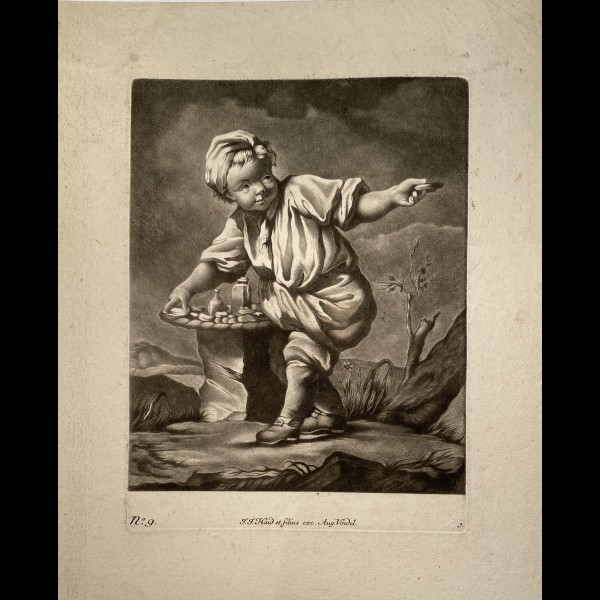
HAID JOHANN-JAKOB (1704-1767) - LE PETIT MARCHAND DE GATEAUX
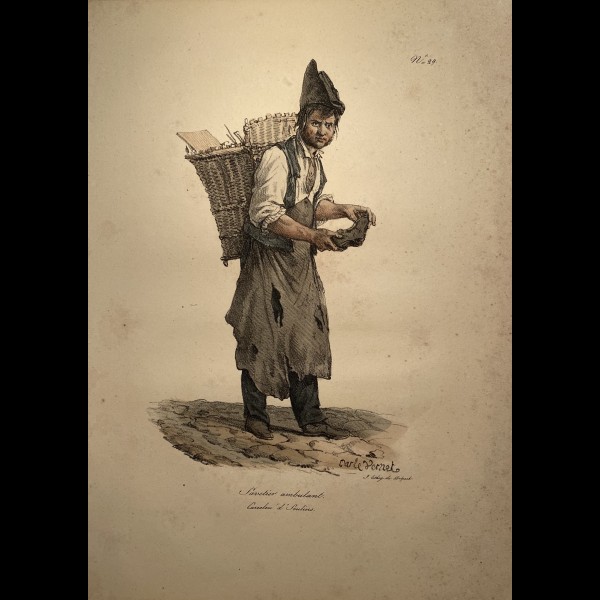
VERNET CARLE ( 1758-1836 ) - SAVETIER AMBULANT

SAVETIER AMBULANT

VERNET CARLE ( 1758-1836 )

From the set : CRIS DE PARIS, DESSINÉS D'APRÈS NATURE PAR C. VERNET. Paris, Delpech, s.d. (ca. 1820)..

VERNET CARLE ( 1758-1836 ) - MARCHANDE DE CHIFFONS

MARCHANDE DE CHIFFONS

VERNET CARLE ( 1758-1836 )

From the set : CRIS DE PARIS, DESSINÉS D'APRÈS NATURE PAR C. VERNET. Paris, Delpech, s.d. (ca. 1820)Scattered freckles...

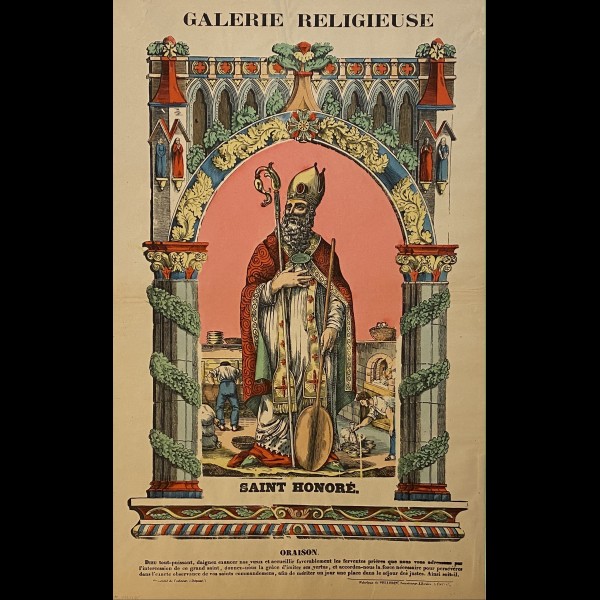
PELLERIN JEAN-CHARLES (1756-1836) - GALERIE RELIGIEUSE. SAINT HONORE

GALERIE RELIGIEUSE. SAINT HONORE

PELLERIN JEAN-CHARLES (1756-1836)

2e quart 19e siècleBelle feuille aux coloris très frais, courtes déchirures marginales éditée par la fabrique Pellerin à Epinal.Numéro d'inventaire  Musée de l'Image  Epinal :  D 996.1.1090 C..

DE LARMESSIN NICOLAS I ( 1632-1694 ) - LA CONFISEUSE

LA CONFISEUSE

DE LARMESSIN NICOLAS I ( 1632-1694 )

From the set of Grotesque Costumes and Trade Clothes.Proof with some color highlights, cut to the limit of the copper on the right border, thinning of the paper and small loss on the back of the left margin.The address of Chiquet (active circa 1707-1721) allows us to date the print to around 1710.Even more than Arcimboldo, the engravings are part of a tradition that dates back to the 16th century, that of masquerades or freer court balls where costumes were “rather made to entertain and give entertainment, than to appear magnificent ” (Mercure galant, March 1683, p.325).Certain ballet costume plates, engraved by Lepautre after drawings by Berain or Gissey, certainly also inspired the engravers behind the Grotesque Costumes series."Maxime Préaud thus provided an unprecedented ordering and enumeration of a series "of variable dimensions [published] in several installments" while providing valuable documents to understand its genesis and its fortune. He identifies the three chronological phases of its creation and publication, by Nicolas I (author of the “first series”, divided into two sub-series), by his widow Marie Bertrand then by his younger brother Nicolas II, before reissues by Jean Colart, François Hurand or Jacques Chiquet.” "The first episode, the most important, includes 62 plates: it is the initiative of Nicolas I de Larmessin (1632-1694). 14 plates are then published by his widow, “between May 23, 1694 and May 20, 1701 , perhaps engraved after drawings by her late husband...As for Nicholas II [1645-1725, younger brother of Nicholas I but who was not his heir], he published 22, which he draws and engraves himself, at the address of the Golden Cup, from 1695”Roger-Armand Weigert, "Sur les Larmessin et les Costumes Grotesques", in Nouvelles de l’estampe, 2, 1969, pp. 67-75Pascale Cugy, « Un nouveau chaînon dans la genèse des Costumes grotesques de la famille Larmessin », Nouvelles de l’estampe [En ligne], 263 | 2020, mis en ligne le 20 juin 2020, consulté le 23 août 2024. URL : http://journals.openedition.org/estampe/1416 ; DOI : https://doi.org/10.4000/estampe.1416Maxime Préaud,"L'estampe au Grand Siècle : études offertes à Maxime Préaud", Edité par Ecole des chartes. Paris ; Bibliothèque nationale de France - 2010..

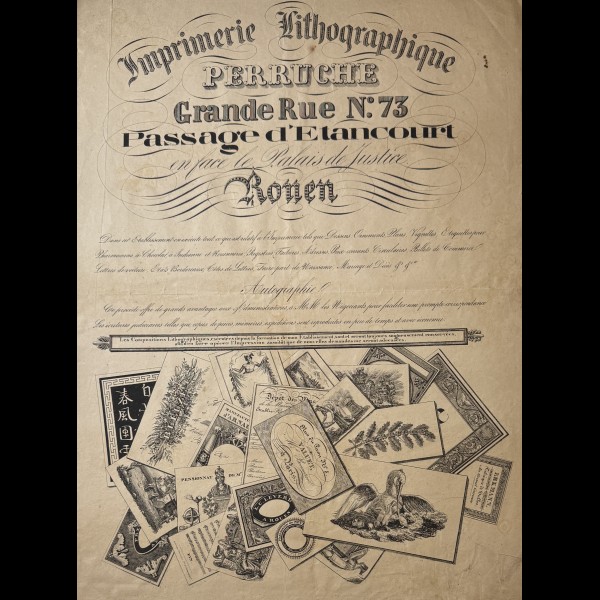
PERRUCHE ANTOINE-SAUVEUR ( 1799-APRES 1850 ) - IMPRIMERIE LITHOGRAPHIQUE PERRUCHE, ROUEN

IMPRIMERIE LITHOGRAPHIQUE PERRUCHE, ROUEN

PERRUCHE ANTOINE-SAUVEUR ( 1799-APRES 1850 )

Poster for the Perruche printing house in Rouen.First half of the 19th century.Uniform dusting, creases, tear (previously reinforced) along the right edge for 10 cm.Antoine-Sauveur Perruche was born in Seillans, Var, on February 14, 1799. He worked as a lithographer in Paris at the beginning of 1820, first with Langlumé and others, then with Periaux for six months. From June 1822 to November 1823, he worked for the customs administration.After working for Periaux in 1821, which he left in January 1822, he sought to set up his own business; he made numerous applications in Elbeuf and Rouen. He also contacted Godefroy Engelmann, who could have provided him with capital in exchange for his labor; the deal fell through. Although without a patent, he owned a printing press as early as 1822, then two. His workshop, operating illegally, was closed in 1825, after he had printed a few Napoleonic lithographs. He finally obtained a patent in 1826. He printed texts and petitions. and autograph scores as well as lithographed views.He encountered the same difficulties when he applied for a letterpress printing license in 1848 and 1849.In the debate that stirred printers in 1838 over who had first produced a typolithographic transfer print, he was credited with trials conducted as early as 1821. In 1824, he also produced transfers on earthenware from the Forges factory.In: Dictionary of 19th-Century Printers and Lithographers, École Nationale des Chartes, Online Editions of the École des Chartes..

BONNART HENRI (1642-1711) - CRIEUR D' EAU DE VIE

CRIEUR D' EAU DE VIE

BONNART HENRI (1642-1711)

Nice print, cut proof at the limit of copper..

1 to 8 of 8 (1 Pages)