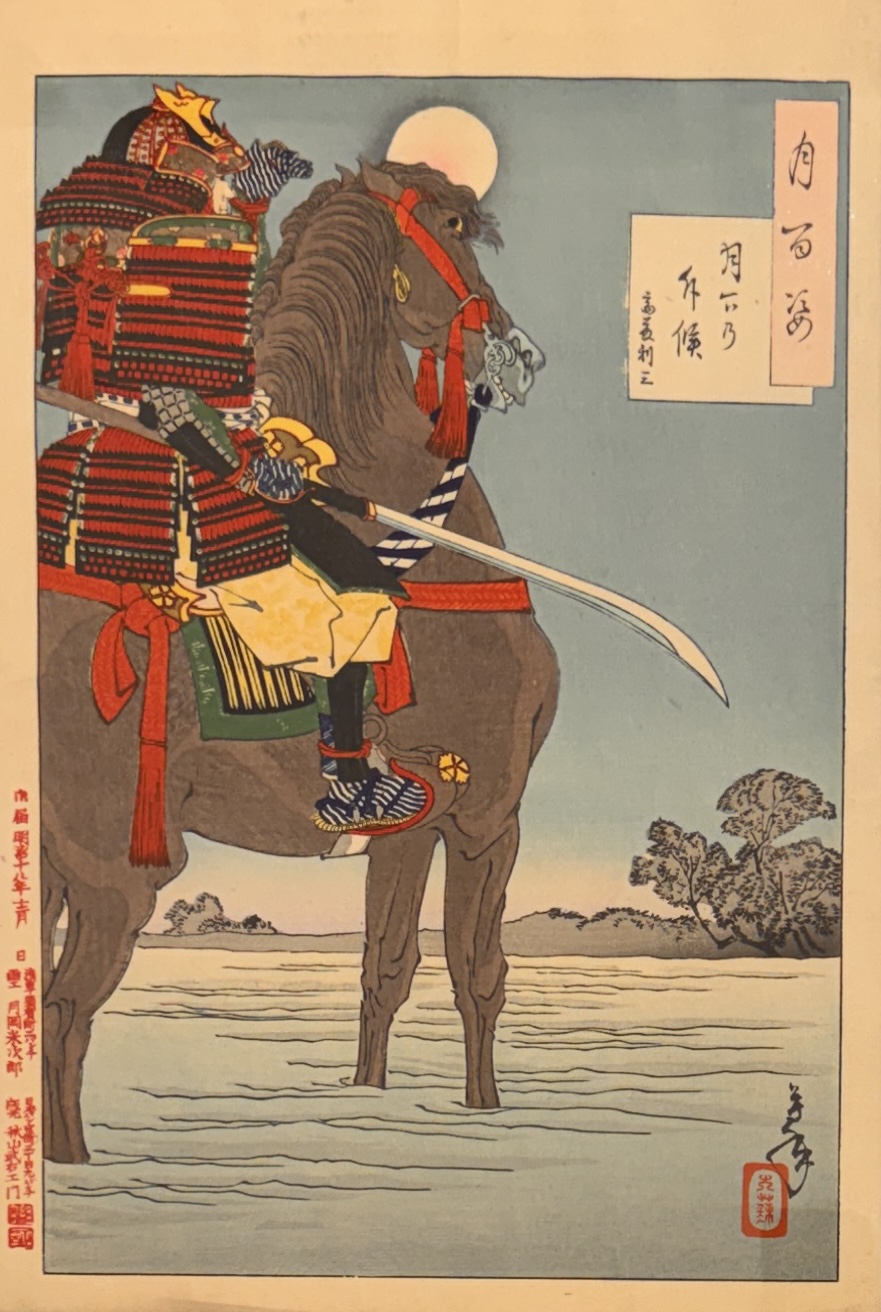
No. 8 from the series: Tsuki no hyakushi (One Hundred Aspects of the Moon)
1885
Seal: Taiso
Oban
nishiki-e
Fine impression with embossing, some handling creases in the outer edges.
Eighteen months after Hideyoshi's victorious assault on Mount Inaba, Oda Nobunaga had gained control of most of Japan, but cities and countryside teemed with potential rivals. This print again deals with the Saito clan of Mino Province, whose castle had not yet been razed, and whose loyalty to Nobunaga remained uncertain.
It depicts an episode from the Taikōki, the "Chronicle of the Taikō." This title of taikō, meaning "regent," was the one Hideyoshi had assumed. Toshimitsu was a Saito general. His father, Kuranosuke, was one of the principal vassals of Akechi Mitsuhide (1526-1582). As a reward for his allegiance to Nobunaga, Mitsuhide had received a large fief; but soon, Nobunaga publicly reproached him for the destruction of Yakami Castle and the massacre of all its occupants. Wounded in his pride, he alleged in his defense that the lord of the castle had murdered his mother.
At a banquet, Nobunaga—who was drunk—humiliated him again by striking his head with a fan to mock his baldness. Mitsuhide waited for the first opportunity to redeem his honor. This came in the summer of 1582 when Nobunaga, based at Honnoji Temple in Kyoto, sent the bulk of his troops to reinforce Hideyoshi, who was campaigning in the western province of Bithu. Mitsuhide marched toward Bithu at the head of his thirty thousand men, but, suddenly urging them to turn back with the cry, "The enemy is at Honnoji!" (that is, at Honnoji Temple), he ordered them to march on Kyoto. Nobunaga was taken by surprise in his headquarters and massacred.
Having unsuccessfully urged Mitsuhide to renounce such treachery, Toshimitsu and his father resigned themselves to following him as loyal vassals. Here we see Toshimitsu on his reconnaissance mission: heavily armed, he advances one full moon night to the Kamo River, which is to lead the conspirators to the heart of Kyoto and to Nobunaga's hideout. His main weapon is a naginata, a spear with a long, curved blade. In the distance, the last rays of the sun still paint the sky pink.
Akechi Mitsuhide's triumph would be short-lived: two weeks later, he would be defeated by Hideyoshi and killed by bandits. As for the two Saito brothers, they would flee but would be quickly captured (the rest of their adventures appear later in the series). The father would be put to death, and Toshimitsu would become a monk.
Although the very low viewpoint suggests the effect of a snapshot, the composition probably owes nothing to photography. The reference is rather to be found within the ukiyo-e tradition itself: Yoshitoshi seems to be making a subtle allusion to the figures and landscapes of Hiroshige, sometimes seen from the rump of a horse. Yoshitoshi himself knew how to surprise with his compositions: this is evidenced by an early print where the left edge cuts off most of a figure. Mid-19th-century ukiyo-e was far more daring in this respect than late-century Japanese photography, with its staged scenes designed to mimic painting. Many photographers at the turn of the century, such as Alfred Stieglitz and his Photo-Secession group, claimed the influence of Japanese prints on their way of "seeing" the world.
In: ONE HUNDRED ASPECTS OF THE MOON, John Stevenson, 2018, Editions Citadelles and Mazenod
The series "One Hundred Aspects of the Moon", inspired by historical or legendary tales from China and Japan, is Yoshitoshi's most famous series, begun in 1885 and completed just before his death in 1892. Even then, each new print published was an event, with prints often selling out on the morning of their release.
PATROUILLE AU CLAIR DE LUNE, SAITO TOSHIMITSU
- Author : YOSHITOSHI TSUKIOKA (1839 - 1892)
- Technic: Xylographie
- Width : 225.00
- Height : 330.00
- Leaf width : 250.00
- Leaf height : 370.00
- Availability: In Stock
-
1,000.00 €