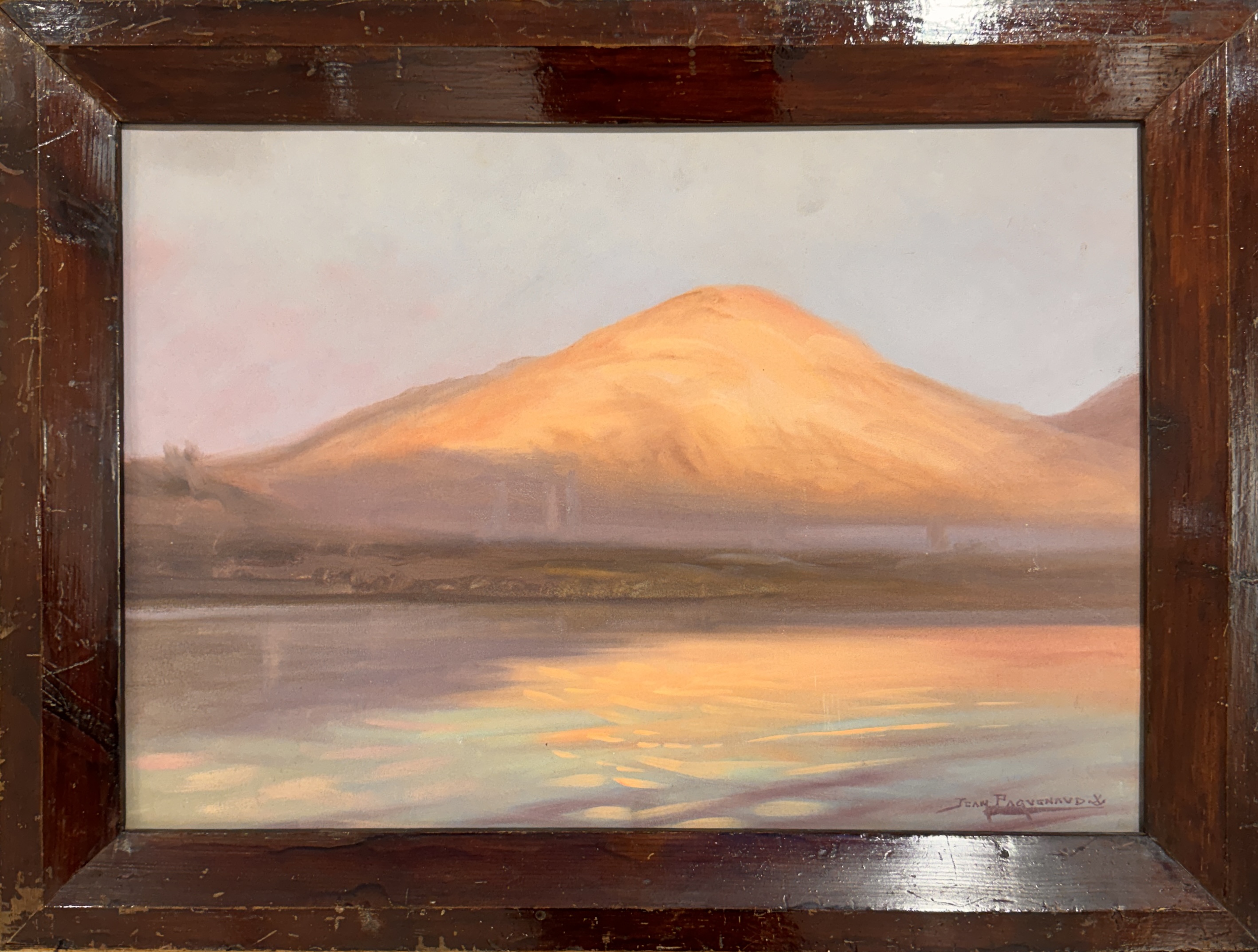
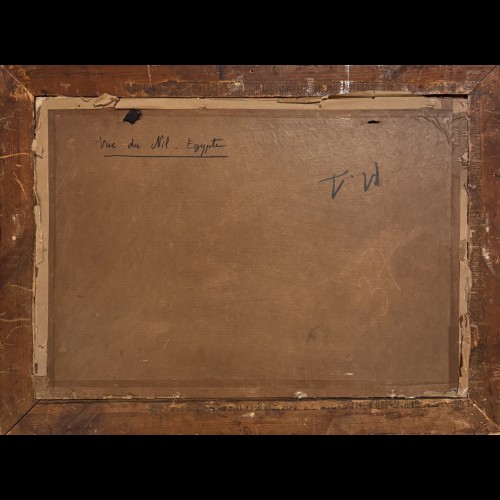
A very fine gouache, framed, signed lower right, with the inscription on the back "View of the Nile, Egypt."

Minor soiling in the sky and light scratches.

A traveling painter, Paguenaud trained under the academic painter William Bouguereau, whose classes he attended in Bordeaux before continuing his studies at the Académie Julian in Paris. In 1922, he was appointed painter to the French Navy, a title which earned him Paul Valéry the description "Admiral of Painters and Painter of Admirals." The artist showed early on a desire to discover the world. "I am going to fulfill one of the dearest dreams of my life," wrote Paguenaud when he embarked for the first time in 1902. "To go there, far away, towards the unknown of the Tropics whose very name awakens in me something that troubles me in a crazy way." From this first trip, which brought him to Martinique at the time of the eruption of Mount Pelée, he brought back a travel journal.From then on, Jean-Louis Paguenaud was constantly at sea. Between 1903 and 1912, on the schooner of his friend Casimir Sobanski, the Polish painter, he sailed the Mediterranean and brought back paintings from Beirut, Alexandria, and Cairo. In 1925, on the cruiser Duguay-Trouin, he explored the African coast and brought back dozens of gouache paintings. In 1927, on the cruiser Lamothe-Piquet, he sailed around South America, stopping in Argentina, Brazil, the Cape Verde Islands, French Guiana, and Uruguay.

On view : 345x500

With frame : 460x615


VUE DU NIL, EGYPTE

  • 1,200.00 €


”instagram_icon”

Guarantee of Authenticity

All our prints and engravings are guaranteed to be original.

Art Gallery in Paris

11 Passage Verdeau, Paris 9th. Recognized expertise in ancient and modern prints, Japanese and European. Member of SLAM (Syndicat de la Librairie Ancienne et Moderne) and ILAB (International League of Antiquarian Booksellers)

Conservation Museum Quality

Flat packaging, acid-free folders with neutral pH and reinforced protection.

Shipping within the European Union

Careful delivery within 24/48 hours with ad valorem insurance and real-time tracking.

Frequently Asked Questions from Collectors & Print Lovers

Answers on the authenticity, conservation and acquisition of Japanese prints and Master engravings.

How are the prints packaged and secured during delivery?

En résumé : The prints are protected in a neutral acid-free pouch, packaged strictly flat between two plates of rigid reinforced non-deformable cardboard with ad valorem insurance.

Prints are preferably shipped flat to preserve the fiber of the paper. Packages are shipped within 24 to 48 hours via Colissimo Expert with delivery against signature or express carrier (DHL / FedEx) with tracking number. Collection by hand from our Parisian gallery (11 Passage Verdeau) is also available during opening hours or on request.

How can we guarantee the authenticity and period print of an original print?

En résumé : An original print is verified by its edition, determined largely by the nature of its paper and the quality of its printing.

At the Maillard-Fouilleul Gallery, each work undergoes an in-depth examination, mention in the dedicated catalogs or directories, quality of the print and printing, possible presence of a watermark and its identification as well as any signature, sending or collector's mark, state of conservation of the print, integrity of the margins.

What is the difference between an Ukiyo-e print and a Shin-Hanga print?

En résumé : Ukiyo-e (17th–19th century) illustrates the classic “floating world” of Edo, while Shin-Hanga (20th century) renews woodcut with Western perspectives and light effects.

Ukiyo-e brings together illustrious masters like Hokusai, Hiroshige, Utamaro and Sharaku. The favorite subjects are actors, kabuki, courtesans or Bijin and landscapes, nature and its seasons being at the heart of art and the art of living in Japan. The Shin-Hanga (“new prints”) movement, launched by the publisher Watanabe Shozaburo in the years 1915-1960 with Hasui Kawase and Hiroshi Yoshida, preserves the traditional technique on wood with the intervention of a designer, an engraver and a printer, while infusing a spectacular atmospheric realism. To this we must add Sosaku-Hanga ("creative prints"), the creative process of which is in the hands of the artist alone and whose palette and graphic expression are freer.

How to properly preserve and frame a Japanese print or old engraving?

En résumé : Store prints away from UV rays and excessive humidity. Use only acid-free (neutral pH) mats and museum-quality anti-UV glass.

Inks like paper are very sensitive to direct light and humidity. We recommend reversible assembly with neutral pH or Japanese starch-based hinges, avoiding any synthetic adhesive. Never glue a print in full. For storage in drawing board, choose neutral polyester pouches (Melinex/Mylar) and permanent blotting paper.

Can you have your European and Japanese prints appraised or sold at the gallery?

En résumé : Yes, we examine your works for cash purchase, or valuation notice on photographs.

We are constantly looking for Japanese prints (Ukiyo-e, Shin-Hanga, Sosaku-Hanga), as well as engravings by ancient or modern European masters: Dürer, Callot, Bosse, Nanteuil, Boucher, Delacroix, Gericault, Goya, Rodin, Redon, Miro, Chagall, Buffet, Delaunay, Vasarely. You can send us photos by email to maillard.estampes@orange.fr or come and meet us directly at Passage Verdeau in Paris.

Galerie Maillard-Fouilleul · Specialist in ancient and modern prints · Ref. bibliographic: Hollstein, Bartsch, Le Blanc, I.F.F, Delteil, Last update: 09/2026.