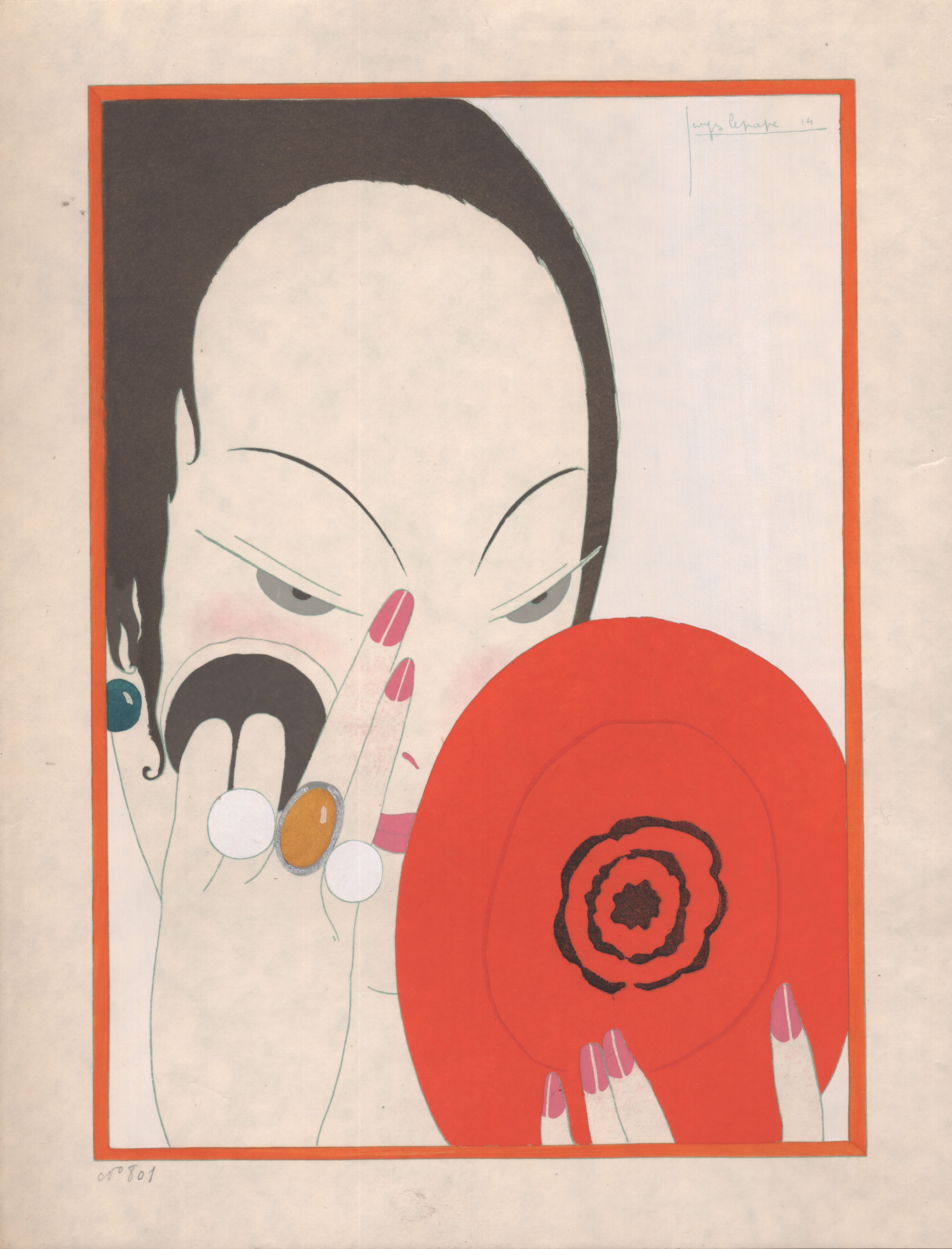
Beautiful stencil printed on pearlescent Japanese paper.
Minor abrasion in the bottom margin.
Silver highlights on the ring and the center of the mirror.
Deluxe edition from the magazine: Les Feuillets d'Art
Numbered proof 801
1919
It was with "Les Choses de Paul Poiret" in 1913, a sequel commissioned by the couturier to "Les Robes" in 1911, that the young Lepape laid the foundations for what would become his signature style: the influence of Japanese prints and the Ballets Russes, adapted to the demands of fashion.
This was a new era, both for fashion and for the engraving that depicted it. Abandoning mechanical color printing processes, illustrators brilliantly employed the stencil technique, championed by Jean Saude, himself an illuminator. The vibrancy and warmth of the tones, which had temporarily disappeared, were revived, giving fashion engraving a charm it had lost. At the time, this renewed interest in stenciling, a process particularly well-suited to their style, contributed to the production of a large part of their work. This technique had a long history in France, as it is known that playing card manufacturers were already using it in 15th-century Lyon.At the time, the support was a sheet of oiled cardboard, but the process perfected in France in the 20th century used a zinc or bronze plate. Skillfully employed, these perforated stencils allowed for the layering of colors and the reproduction of the original's hues, achieving almost infinite complexity. Jean Saude, one of the leading specialists in this technique, used more than thirty stencils to capture the freshness of a delicate watercolor.
Compared to photographic or entirely mechanical reproduction methods, stenciling was slow and laborious, but this was precisely the reason for its popularity with Saude, Vogel, and other publishers who sought the highest quality. Proceeding in successive layers, and thus preserving the virtues of handwork at every stage, it allowed for the creation of copies that remained remarkably faithful to the spirit of the original.
From Japanese prints, Lepape and many others had learned to arrange curvilinear figures against a rectilinear background, to create an impression of tilting, spiraling, and aerial height with an economy of means pushed to the extreme, often achieving this new vibrancy by completely eliminating the background. In their compositions, the foreground is often steeply inclined, causing the background to disappear, the background then becoming a backdrop, as in a theater. The bold palette of the Fauves and the brighter colors adopted by haute couture gave illustrators the courage to begin using previously unheard-of contrasts. The Cubists brought new interpretations of mass and space.
The Red Mirror clearly indicates this new spatial balance, the unprecedented experiments with color, and the bold treatment of the human face, all fueled by an observation of a world permeated by new technologies and a thirst for distant horizons. These few brushstrokes for the eyebrows, nose, and mouth lend the model a sensual exoticism inspired by Japan, which the mirror, in a beni iro hue (the color of eyeshadow), and the delicate hands with their momo iro pink (peach-colored) nails reinforce and amplify. Here, too, we find an aesthetic undoubtedly drawn from the contemplation of the new interpretations of the human face established by Modigliani, but also from the influence of silent cinema, where lighting effects accentuated an exaggeratedly heavy eyelid against livid complexions, thus blurring the contours to give faces an ethereal quality.
Bibliography:
-La Gravure De Mode Feminine En France, Raymond Gaudriault, Les éditions de l'amateur, 1983
- La Mode Art Déco, L'âge D'or Du Style, Julian Robinson, Editions Atlas, 1977
LE MIROIR ROUGE
- Brand: LEPAPE GEORGES (1887-1971)
- Product Code: Pochoir
- Availability: In Stock
-
1,200.00 €