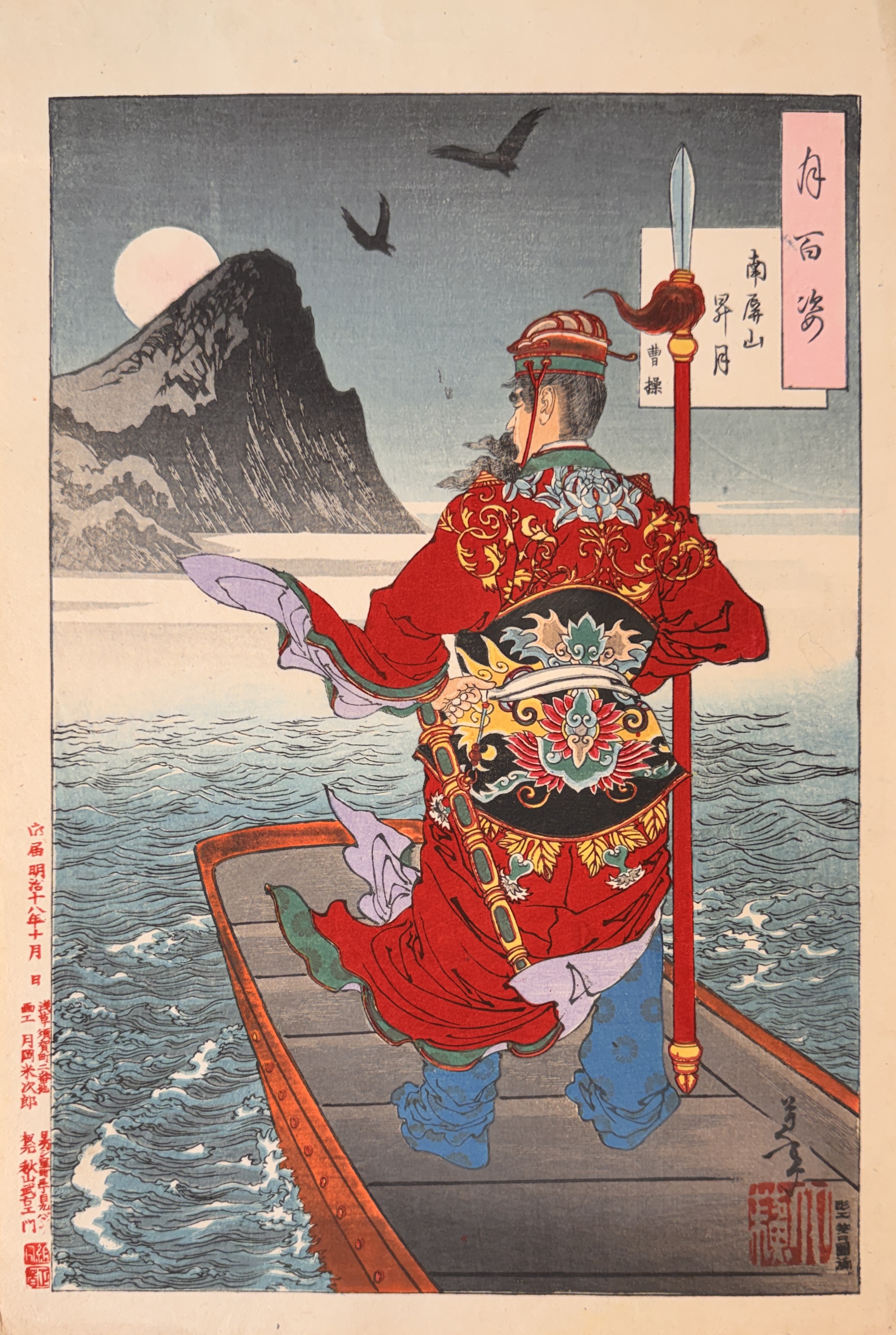
Où Cao Cao
Nanpeizan shogetsu - Soso
N°3 De la suite : Tsuki No hyakushi ( Les cent aspects de la lune )
1885
Sceau:Taiso
Graveur : Enkatsu
Oban
nishiki-e
Belle épreuve aux frais coloris.
Cette estampe s'inspire d'un épisode fameux du Sanguo yanyi, le roman des Trois Royaumes, récit semi-historique, écrit au xive siècle et toujours très lu par les Chinois modernes.
Il évoque les guerres civiles qui déchirèrent la Chine au début du IIIème siècle, lorsque l'empire des Han se morcela en trois royaumes.
Le personnage principal, Cao Cao (Sösõ en japonais), était le fils d'un soldat de second rang. Il se fit connaître en écrasant la révolte des Turbans jaunes en 184. Après avoir chassé les rebelles de la province du Shandong, dans le nord-est de la Chine, il chercha depuis cette base à s'emparer du trône impérial - il échoua, mais son fils devint le premier empereur de la dynastie des Wei. Cao Cao ne vécut que pour l'intrigue et la traîtrise et bien qu'il fasse figure d'anti-héros, c'est l'un des protagonistes les plus séduisants du récit, dépeint comme un homme courageux et déterminé.
On le voit ici traverser de nuit le Changjiang (le Yangzi ou «Fleuve bleu»), à la veille de la bataille décisive de la Falaise rouge. A la tête d'une flotte comptant quelque 830 000 hommes, il se tient à la proue de son bateau : Yoshitoshi signe une figure d'une admirable prestance.
Les étoffes volent au vent, la brume tapisse les eaux du fleuve. La lune surgit au loin derrière la falaise, et deux corbeaux volent dans le ciel.
Dans le roman, Cao Cao tient un grand banquet à la veille de la bataille, en compagnie de ses généraux. Importuné par le croassement de quelques corbeaux, il veut savoir pourquoi les oiseaux font entendre dans la nuit ce cri de mauvais augure: c'est, lui répond-on, parce que la pleine lune les empêche de dormir. Passablement ivre, il balaie le présage funeste en brandissant la grande lance qu'on lui voit chez Yoshitoshi: il triomphera, clame-t-il, comme il a toujours triomphé. L'un de ses hommes lui rappelle que les circonstances imposent la prudence: Cao Cao le tue, puis donne, dans l'atmosphère soudain devenue lugubre, ses ordres pour la bataille. Ce sera une défaite cuisante.
Les Japonais cultivés du temps de Yoshitoshi étaient familiers de tels emprunts à la grande littérature chinoise, dont l'influence souveraine irriguait la culture nippone depuis des siècles. Un cinquième des récits illustrés dans la série renvoient à la Chine.
Dans le cartouche de titre, l'on remarque que le nom de Cao Cao est soigneusement écrit en caractères chinois classiques, très réguliers. Selon un dicton chinois, «Qu'on parle de Cao Cao, et Cao Cao apparaît»
In : CENT ASPECTS DE LA LUNE, John STEVENSON, 2018, Editions Citadelles et MAZENOD
La suite des « Cent aspects de la lune », inspirée de récits historiques ou légendaires de la Chine et du Japon, est la plus célèbre série de Yoshitoshi commencée en 1885 et terminée juste avant sa mort en 1892. A l'époque déjà, chaque nouvelle estampe publiée était un événement, les tirages s’épuisant bien souvent dès le matin de leur parution.
LEVER DE LUNE SUR LE MONT NANPING
- Auteur : YOSHITOSHI TSUKIOKA (1839 - 1892)
- Technique : Xylographie
- Largeur : 220.00
- Hauteur : 330.00
- Largeur Feuille : 250.00
- Hauteur Feuille : 370.00
- Disponibilité : En Stock
-
1 000,00 €