
1903
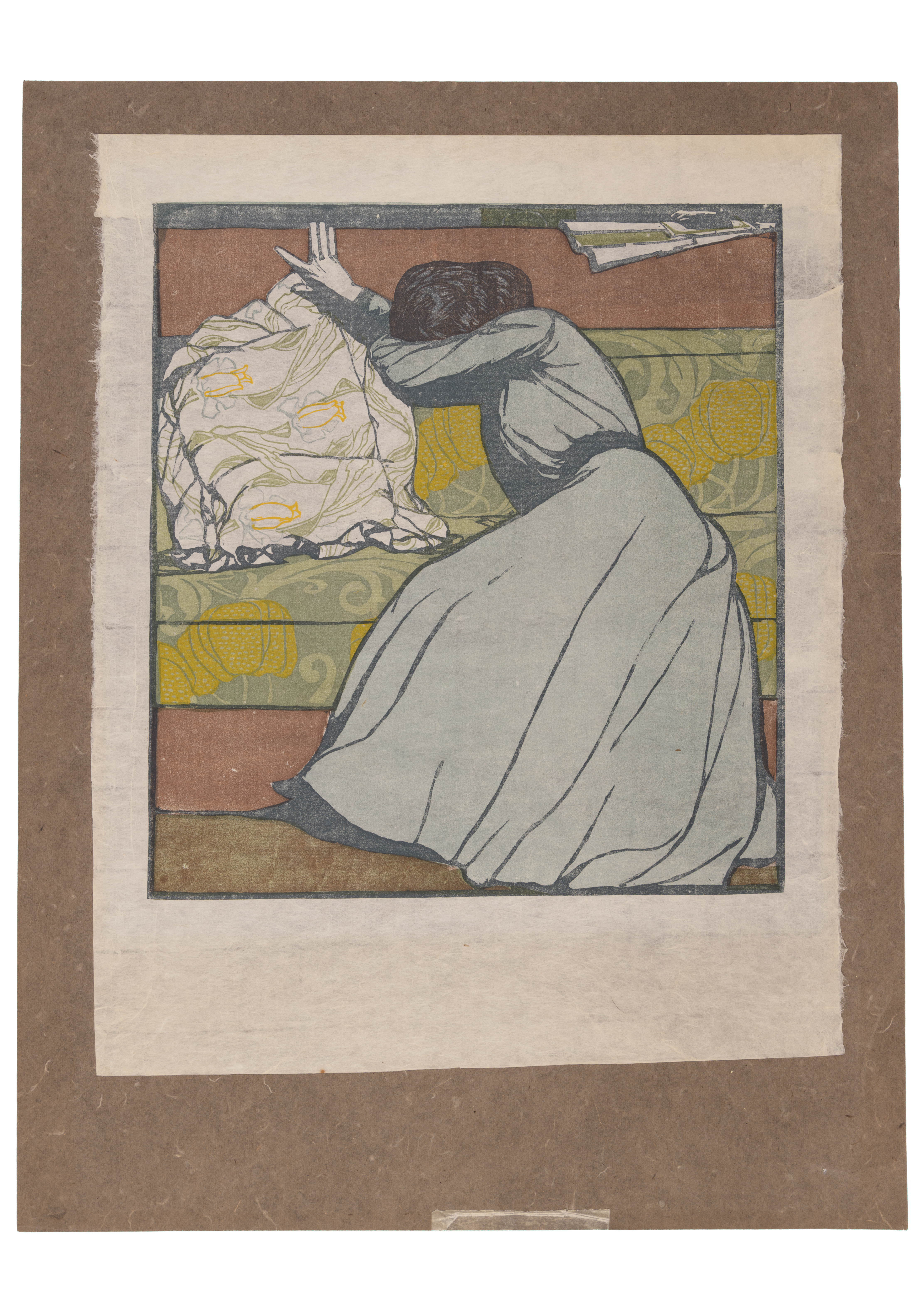
Color printed woodcut, 285 x 260 mm (sheet: 385 x 305 mm), Novotny-Adolph 428 group B.
Proof on fine Japanese paper published in the journal Jahresmappedes Geselschaft für
Vervielfältingende Kunst in Wien in five colors, yellow, green, brown, blue, black. There are variations in the print, this test belongs to "group B" blue dress, green sofa, gray tint. Proof mounted on its original support in Japanese bis paper.
It is Martha Kurzweil, his wife, seated on a couch.
Relatively early, at the beginning of the 1890s, a decisive change occurred in Kurzweil's life and art, when he came into contact with French painting. He worked in Paris from 1892 to 1894 and made regular summer stays in Concarneau where a colony of artists, including Signac and Andri, was established. What particularly marked him was the painting of Vuillard and Bonnard, and the black and white graphics of Vallotton. It was also at this time that he met Martha Guyot, daughter of a merchant and deputy mayor of Concameau. The following summer, they became engaged and then married in 1895.
The most important of Kurzweil's rare prints is this color woodcut.
In Kurzweil's work, this woodcut clearly embodies the personality of the artist and at the same time the essence of an artistic movement, even the essence of the face of a century.
Much of what Art Nouveau expresses about the spirit of the era can be read in this sheet, the characteristic floral style that we find in the cushion as in the pattern of the sofa. But this “omemental cheerfulness” is counterbalanced by the sobriety of the color of the dress and the position of his wife with her face hidden, buried, as if taking refuge in a melancholy, the same one that was gnawing at the artist.
Max Kurzweil was the co-founder of the Viennese Secession in 1897. He co-edited and illustrated the monthly magazine Ver sacrum of January 1898.
Reference:
-Max Kurzweil, Ein Maler der Wiener Sezession, Fritz Novotny and Hubert Adolph, Jugend &
Volk, 1969