
after Hendrik Goltzius
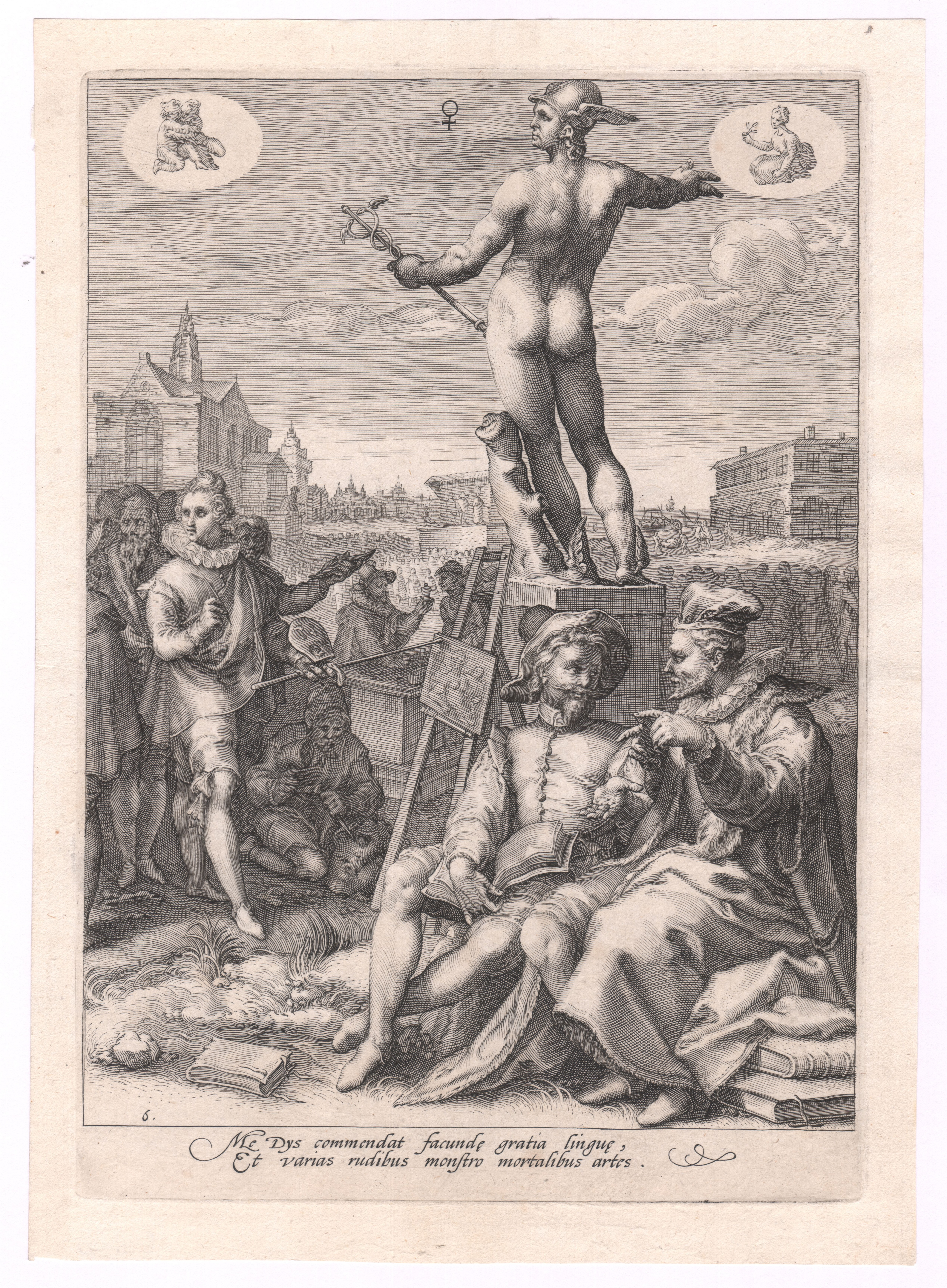
3.Mercury presiding over the arts
Chisel, 256 × 180 mm (sheet: 280 x 200 mm), Hollstein, Saenredam 55, state I/I1; New Hollstein, Goltzius 662 state I/II.
Plate 6 of the suite entitled: Seven planets
Proof of the 1st state before the second number 6 is added at the bottom right.
Shield watermark with band. This type of watermark is of Baden origin; perhaps they can be attributed to EttlingeniẠồ. (Briquet 1075).
Two light transverse folds.
Since Antiquity, astrology has evoked planetary children, the idea according to which an individual born under the influence of a given planet and constellation was characterized by specific qualities and aptitudes. If the Middle Ages retained this vision of the planetary gods and their children, it enriched this conception with the integration of ancient pagan astral beliefs, elements of ancient mythology and divine iconography.
From the end of the 15th century we find in the works of Marten van Heemskerck, as well as Maarten de Vos, representations of divinities in a chariot in their celestial orbit, dominating the planetary children busy with their work on Earth.
The novelty introduced by Goltzius is to represent the gods at human height, incarnated in the form of statues, within a landscape surrounded by these planetary children.
The role of Mercury, recalled by the Latin inscription, attributed to the poet and humanist Cornelius Schonaeus and which could be translated as: “The grace of eloquence commends me, and I show inexperienced mortals the arts in their diversity. I clearly indicate that he is the symbol of eloquence, but also of the transmission of knowledge. Among his children there are two scholars chatting in the foreground and a painter, which clearly means that for Goltzius, art, which is expressed through images, is as important as rhetoric, and therefore as the liberal arts.
Reference:
- Antike Götter als Planeten und ihr Einfluss auf die Erdbewohner, Veldman, Ilja M., in Hendrick Goltzius (1558-1617). Mythos, Macht und Menschlichkeit, Norbert Michels (dir.),
Petersberg, 2017, p. 142-151